
Why Mercedes Batteries Fail Early in Abu Dhabi and How Start-Stop Systems Add to the Strain


There’s never much warning for a Mercedes-Benz battery failure in Abu Dhabi. The automobile starts up just fine Monday morning. By Thursday it’s in a car park with a fully flat battery, a complex array of electrical system alerts and an owner attempting to work out why a car that was operating with no obvious problem has suddenly refused to start. The explanation is always the same two things. Abu Dhabi’s heat environment speeds up the internal depreciation of the battery. A start-stop technology meant to enhance fuel efficiency in cooler regions places a demand on that deteriorated battery it can no longer meet.
Today’s Mercedes-Benz uses an AGM (Absorbent Glass Mat) battery, a sealed, maintenance-free unit chosen for its ability to handle the high charge and discharge cycles required by start-stop systems, regenerative braking, and the heavy electrical load of a fully equipped luxury vehicle. AGM batteries are better than normal lead-acid, but they share the same basic chemistry and that chemistry is particularly vulnerable to extended exposure to heat.
The chemical reactions that eat away at the lead plates and the electrolyte intensify within the battery when it’s heated. Plate sulphation, the formation of lead sulfate crystals that decrease the ability of a battery to receive and distribute charge, occurs faster at high temperatures than the mild ambient circumstances under which battery makers estimate rated life. A Mercedes-Benz battery certified to last four to six years in a European setting could see its effective service life drop to two to three years in sustained Abu Dhabi summer heat. It’s not a production fault, it’s a climate reality that Mercedes maintenance Abu Dhabi technicians see across the fleet on a regular basis.
Under the conditions for which it was developed, the ECO Start-Stop system from Mercedes-Benz is one of the most efficient fuel-saving technologies in the current fleet. In a moderate European climate where the air con is not often running at full blast and the battery temperature is within a comfortable operating range, the start-stop system cycles the engine off at traffic lights, reduces fuel consumption in a meaningful way and the AGM battery copes with the repeated shallow charge-discharge cycles without significant stress.
In Abu Dhabi, the same system is confronted with quite a distinct set of conditions. The air conditioning is running at or near its full capacity for most of the year, creating a constant electrical load that the battery has to supply at every start-stop engine off event. The battery itself is running at a high temperature that reduces the usable capacity to below its rated specification. And the start-stop system cycles more often in Abu Dhabi’s stop-start urban traffic than European driving data suggested.
This means the battery is cycling to deeper discharges and higher temperatures more frequently than it was intended to. In these situations, the state of health of the battery, its actual capacity as a percentage of its rated capacity when new, decreases quicker than the onboard battery management system accounts for. A battery that the BMS reports as healthy at 80 percent state of health may be delivering much less than that value under the combined thermal and electrical load of Abu Dhabi. This is the gap that leads to the surprise failure that looks sudden but has been brewing for months.
Mercedes-Benz automobiles include a sophisticated battery management system (BMS) that monitors the charge state, tracks the charge and discharge cycles and modifies the charging strategy of the alternator, so as to extend the life of the battery. The BMS also supplies the electronic trigger that turns on or off the start-stop function based on the battery status. If the BMS decides that the battery is not healthy enough to support a start-stop cycle, it will temporarily disable the function.
The difficulty is that the BMS evaluates the battery health by its behavior in normal settings. So, a battery deteriorated by persistent heat may appear to fulfill the threshold requirements set by the BMS, but in fact it has substantially less reserve capacity than the system assumes. The consequence is a battery which passes the BMS health check on a cold morning but fails the combined electrical load of a full Abu Dhabi afternoon drive. A more granular assessment of battery health than what the BMS alone provides is an independent conductance test, therefore any Mercedes repair Abu Dhabi examination for repetitive start-stop suppression or inexplicable battery warnings should include one.
Signs of a dying AGM battery in a UAE driven Mercedes are frequently subtle until they are absolute. The first and most constant sign is the start-stop system turning off more often than it normally does. The BMS is notifying you that it’s preventing the function because the battery can’t safely support it. If the engine cranks slowly, especially on hot afternoons after the car has been parked in the sun, the battery’s cold cranking performance is not sufficient for the demands on the starter motor when it is thermally stressed. Battery degradation also comes with electrical system alerts, especially concerning the comfort elements that draw parasitic load (seat memory, ambient lighting, infotainment, etc), as the BMS cuts available power to non-critical systems.
None of these symptoms is severe on its own. Together they form a pattern that will be familiar to any competent Mercedes-Benz service center as a battery nearing the end of its useful service life in conditions found in the UAE.
There are two things to do perfectly when replacing a Mercedes AGM battery for the replacement to be entirely successful. The replacement battery must be the exact AGM specification for the vehicle. Using a conventional lead-acid battery in a Mercedes intended for AGM may result in the alternator adopting the wrong charging strategy for the battery, a shortened battery life and various electrical system issues. Second, the new battery must be registered with the vehicle’s BMS using manufacturer-grade diagnostic equipment. If the system is not registered with BMS, it will continue to use the charging strategy that was calibrated to the state of health history of the old battery, which can lead to the undercharging of the new unit and reduce its life from day one.
A qualified Mercedes repair Abu Dhabi technician will do both tasks as a matter of course. A regular workshop that installs a battery but doesn’t register the BMS is doing half a job and charging for the full one.
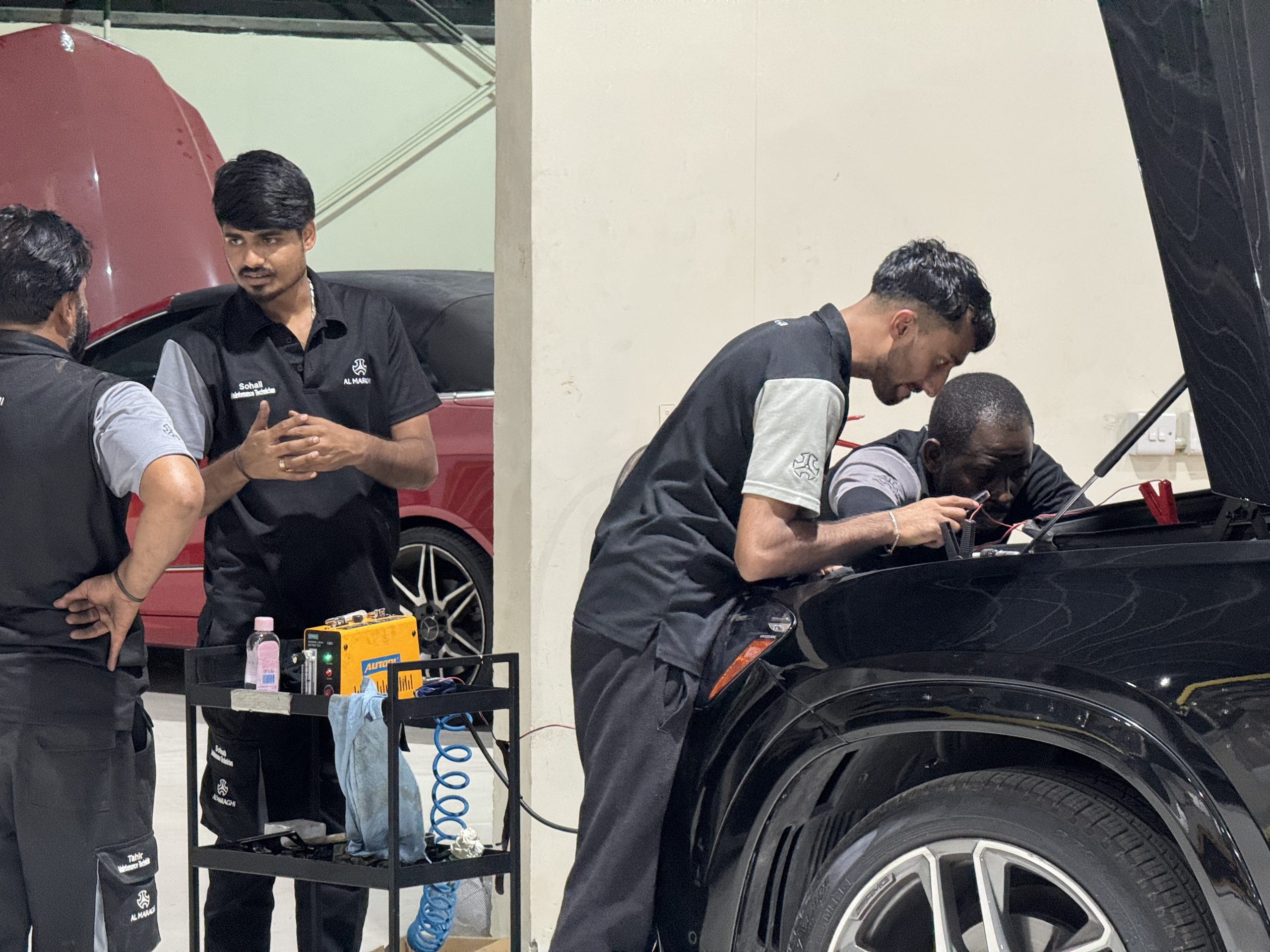
At Al Maraghi in Abu Dhabi, we do a conductivity test to validate diagnosis before any battery replacement, using the correct Mercedes-approved AGM standard, and finish with a comprehensive BMS registration on our manufacturer-grade XENTRY diagnostic system. We also check the charging system, alternator output and voltage regulation to make sure the new battery is charging properly before the car leaves our service. Al Maraghi, an ESMA 5-star certified Mercedes-Benz service center dedicated solely to the brand since 1997, provides the same care to a battery replacement as it does to any other system in the vehicle as there’s no such thing as a simple servicing in Abu Dhabi’s climate.
Trust us for all your Mercedes Benz service needs. Contact us today to schedule your next service appointment or to learn more about our services and how we can help keep your Mercedes running smoothly and efficiently.
contact us now